Part Two of my monster series, this entry will focus on vampires. Stories of the creatures we think of as vampires originated in eastern Europe and quickly spread throughout the early Christian world. In the early days of the Christian church, people often retained superstitions from their pagan beliefs, including belief in ghosts and spirits. When someone died from unknown causes, it was often attributed to a vengeful spirit that had returned from the afterlife. The villagers would dig up the grave of the suspected ghost and burn the body. Their belief that the undead corpse rose from the grave and fed on the blood of the living was only reinforced by what they found when they examined the body. Due to the process of decay, it often appeared that the body was healthy, with elongated fingernails and a bright, healthy-looking face. Since the people in that time didn't realize that all bodies looked like that, that it was natural, they believed it was proof that the suspected vampire was, in fact, returning to drink the blood of the living. As technology and science advanced, these beliefs died out, and vampires retired to the pages of fiction.
Fictional vampiric myth is even more varied than that of werewolves. Most of what we today associate with vampires was added over the last two centuries by authors of fiction. The original vampire stories were more what we now think of as zombies.
In most stories, new vampires are born by being bitten by an existing vampire. However, in the sci-fi show Sanctuary, vampires were an ancient race that once enslaved humans. According to this story, the vampires were highly advanced and used their knowledge to benefit society. When the Church appeared, they hunted down vampires to the point of extinction. A few survivors hid in an ancient city in India, but this, too, was destroyed. The race was all but wiped out, with only a few that carried a fraction of vampiric blood in their history.
Showing posts with label Sanctuary. Show all posts
Showing posts with label Sanctuary. Show all posts
Friday, July 9, 2010

Tuesday, July 6, 2010
Werewolves
Werewolves and vampires are my favorite mythological monsters, so I'm going to do a two-part blog about them. This one is about werewolves, hence the title "Werewolves". The name 'werewolf', (also spelled 'werwolf') is thought to be derived from the Old English word 'wer', meaning man. Another common term is 'lycanthropy', which is from the Greek word 'lykánthropos', meaning 'wolf-human'. Stories of shapeshifters occur in most parts of the world. Ancient cultures often gave their most feared predator shapeshifting abilities in their stories. In South America, it was the jaguar; in Europe, the wolf; and in Korea, it was the fox. Today, it's usually werewolves that are featured in fiction, rather than their Asian or American counterparts.
Modern werewolf mythology varies widely from one author to another. However, of the stories I've seen or read (which, to be honest, are quite few), there are some common themes. Werewolves are immensely strong; they can shift at will with practice; they are most definitely not controlled by the moon; and children cannot shift. It varies whether werewolf blood is hereditary or contagious. In the bloodline myth, werewolf children develop the ability to shapeshift as they mature; the timeline varies from during puberty to well into adulthood. In the contagion myth, those bitten don't always survive, and the odds of survival are even less for children.
Finally, I will leave you with a picture of my favorite werewolf, Henry Foss from the sci-fi show Sanctuary. Henry is played by Ryan Robbins.
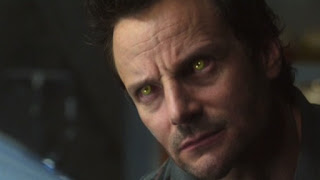
Who's your favorite werewolf? Leave a comment below.
Modern werewolf mythology varies widely from one author to another. However, of the stories I've seen or read (which, to be honest, are quite few), there are some common themes. Werewolves are immensely strong; they can shift at will with practice; they are most definitely not controlled by the moon; and children cannot shift. It varies whether werewolf blood is hereditary or contagious. In the bloodline myth, werewolf children develop the ability to shapeshift as they mature; the timeline varies from during puberty to well into adulthood. In the contagion myth, those bitten don't always survive, and the odds of survival are even less for children.
Finally, I will leave you with a picture of my favorite werewolf, Henry Foss from the sci-fi show Sanctuary. Henry is played by Ryan Robbins.

Who's your favorite werewolf? Leave a comment below.
Subscribe to:
Posts (Atom)